
Blog
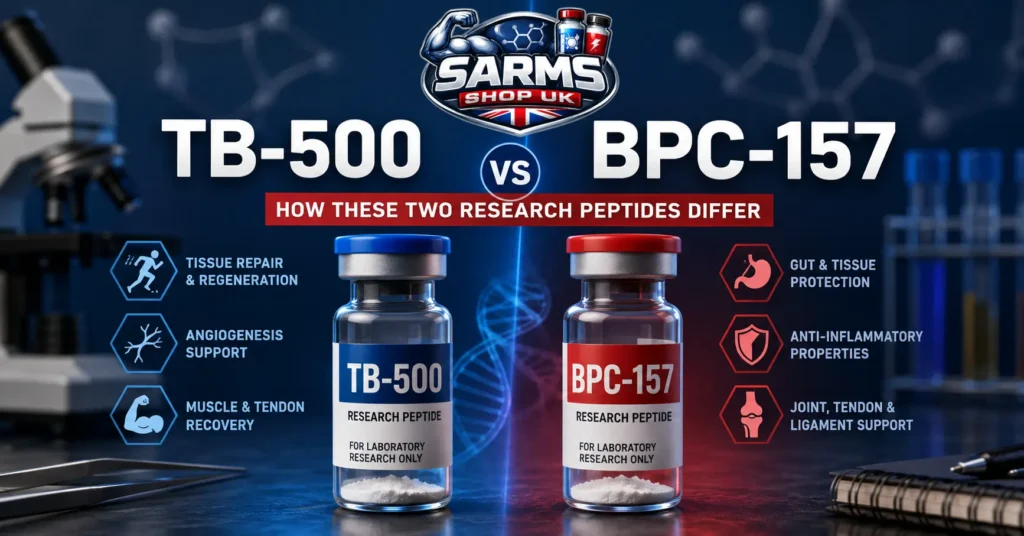
TB-500 and BPC-157: How These Two Research Peptides Differ
Jul
Research peptides have become an increasingly discussed topic within scientific communities investigating tissue biology, cellular signaling, regenerative mechanisms, and laboratory-based healing models. Among the names that appear repeatedly in published studies, conference discussions, and research product catalogs are TB-500 and BPC-157.
Although these two compounds are frequently mentioned together, they are fundamentally different molecules with distinct origins, biological characteristics, and proposed mechanisms of action. Their frequent association has also led to considerable confusion, especially among researchers comparing available laboratory products or reviewing experimental literature.
Structural and Mechanistic Differences Between TB-500 and BPC-157
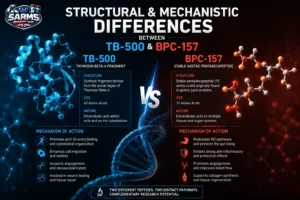
Although TB-500 and BPC-157 are often grouped in research discussions, they originate from entirely different biological sources and possess unique molecular characteristics. Appreciating these structural differences is essential for understanding why each peptide attracts separate areas of scientific investigation.
- TB-500 is considered a synthetic research peptide derived from an active region of Thymosin Beta-4 (Tβ4), a naturally occurring protein widely distributed throughout mammalian tissues. Thymosin Beta-4 has long attracted scientific attention because of its involvement in cellular migration, cytoskeletal organization, and wound-healing biology. TB-500 represents a shorter synthetic fragment designed for laboratory investigation into some of these biological activities.
- BPC-157, by comparison, is a completely different compound. It is described in scientific literature as a stable gastric pentadecapeptide, consisting of fifteen amino acids originally associated with protective proteins found within gastric juice. Researchers have investigated BPC-157 for its stability under challenging physiological conditions and its potential role in maintaining tissue integrity within experimental models.
These different origins immediately separate the two peptides. TB-500 research primarily focuses on mechanisms associated with cellular movement and actin regulation, whereas BPC-157 research frequently examines gastrointestinal protection, vascular responses, tendon models, ligament studies, and inflammatory signaling. Rather than competing compounds, they represent two distinct research tools that may provide complementary insights into different biological systems.
Technical Specifications: Mechanisms & Focus
| Feature | TB-500 | BPC-157 |
| Origin | Synthetic fragment of Thymosin Beta-4 | Stable gastric pentadecapeptide |
| Primary Research Focus | Cell migration, cytoskeleton, and tissue remodeling | Tissue protection, collagen synthesis, and vascular biology |
| Molecular Structure | Short synthetic peptide chain | 15-amino acid peptide chain |
| Major Laboratory Interest | G-actin and cytoskeletal regulation | Gastrointestinal protection, nitric oxide signaling |
| Frequently Studied Areas | Muscle tissue, superficial wound healing, blood vessels | Tendons, ligaments, gut lining, peripheral nerves |
Deep Dive: What the Science Focuses On
TB-500: A Synthetic Fragment of Thymosin Beta-4
One of its most significant biological characteristics involves interaction with G-actin, an essential component of the cellular cytoskeleton. Through actin regulation, researchers believe thymosin beta-4 influences cell migration, tissue remodeling, angiogenesis (the formation of new blood vessels), and wound repair. These biological functions explain why laboratories frequently use TB-500 in experimental models involving muscle injury, tendon remodeling, connective tissue repair, and vascular regeneration.
Scientific investigations continue exploring how TB-500 may influence:
- Actively accelerated cell migration
- Angiogenic blood vessel formation
- Extracellular matrix and connective tissue remodeling
- Inflammatory signaling pathway responses
BPC-157: A Stable Gastric Pentadecapeptide
The compound derives from a protective protein sequence associated with gastric juice and has become well known for its remarkable stability during laboratory testing. Its designation as a pentadecapeptide simply means the molecule contains fifteen amino acids arranged in a specific sequence. This relatively small structure has enabled researchers to investigate its behavior across numerous experimental injury models involving tendons, ligaments, muscles, nerves, blood vessels, and gastrointestinal tissues.
Several published studies suggest that BPC-157 may influence multiple biological pathways simultaneously rather than acting through a single mechanism. Researchers have examined interactions involving:
- Nitric oxide (NO) signaling pathways
- Vascular endothelial growth factor (VEGF) responses
- Type I and Type III collagen synthesis
- Gastrointestinal mucosal protection and vascular stability
Preclinical Research Overlaps and Gaps
Despite overlapping research themes in soft-tissue regeneration, the available literature does not support treating one peptide as a replacement for the other. Instead, their differing mechanisms make them valuable research tools for investigating complementary aspects of tissue biology.
| Research Area | TB-500 | BPC-157 |
| Muscle Injury Models | ✓ Extensive literature | ✓ Extensive literature |
| Tendon Repair | ✓ Well documented | ✓ Highly studied |
| Ligament Healing | Limited data | ✓ Extensive literature |
| Gastrointestinal Protection | Rare | ✓ Primary research focus |
| Angiogenesis | ✓ Extensive (Actin-driven) | ✓ Extensive (VEGF/NO-driven) |
| Cell Migration | Primary mechanism | Secondary mechanism |
| Nitric Oxide Signaling | Limited evidence | ✓ Frequently investigated |
| Peripheral Nerve Models | Emerging | ✓ Active area of research |
Why Some Research Protocols Examine TB-500 and BPC-157 Together
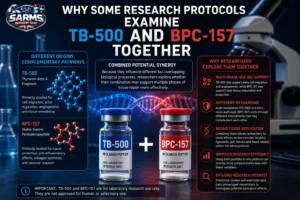
As peptide research has expanded over the past decade, interest has grown in studying combinations of biologically distinct compounds rather than evaluating each peptide in isolation. This trend explains why BPC-157 TB-500 blend products have become increasingly visible within research supply catalogs.
The rationale is not that both peptides perform the same function, but that their different biological characteristics may provide complementary, synergistic insights when evaluated under controlled laboratory conditions.
┌────────────────────────────────────────┐
│ BIOLOGICAL TISSUE REPAIR │
└───────────────────┬────────────────────┘
│
┌─────────────────────────┴─────────────────────────┐
▼ ▼
┌───────────────────────┐ ┌───────────────────────┐
│ TB-500 │ │ BPC-157 │
├───────────────────────┤ ├───────────────────────┤
│ • G-Actin Regulation │ │ • Collagen Synthesis │
│ • Cellular Migration │ │ • Vascular Stability │
│ • Early Tissue Org. │ │ • NO & VEGF Signaling │
└───────────────────────┘ └───────────────────────┘
Researchers interested in combination protocols often hypothesize that TB-500’s association with cellular migration and tissue remodeling could complement BPC-157’s documented investigation into vascular biology, collagen organization, and tissue protection. From a theoretical perspective, one peptide may influence early phases of tissue repair (such as cell recruitment). At the same time, the other may contribute to later structural remodeling processes (such as collagen cross-linking).
Sourcing & Analytical Considerations for Blends
As research protocols become more sophisticated, many laboratories seek standardized peptide formulations that simplify experimental preparation while maintaining consistency across multiple studies. This demand has contributed to growing interest in products marketed as a pre-mixed BPC-157 x TB-500 blend.
Instead of preparing two separate peptide solutions before every experiment, researchers may choose blended formulations to reduce preparation variability and improve consistency between experimental groups. Standardized ratios also make it easier to reproduce study conditions across multiple laboratories, provided the peptide manufacturer supplies accurate analytical documentation.
Critical Quality Control Reminder: Purchasing a blend introduces additional strict validation requirements compared with buying a single peptide. Laboratories must verify not only the overall purity of each peptide via High-Performance Liquid Chromatography (HPLC) and Mass Spectrometry (MS), but they must also confirm whether the stated blend ratio (e.g., 1:1, 5 mg:5 mg) accurately reflects the actual quantitative material inside the vial. Inconsistencies can completely disrupt dose-dependent biological responses and skew experimental reproducibility.
Frequently Asked Questions
Are TB-500 and BPC-157 the same peptide?
No, they are fundamentally different compounds. TB-500 is a synthetic fragment derived from Thymosin Beta-4, a protein naturally found in mammalian tissues that regulates cellular migration. BPC-157 is a 15-amino-acid peptide (pentadecapeptide) originally isolated from gastric juice, known for its systemic tissue-protective properties.
Can TB-500 be used as a direct substitute for BPC-157 in laboratory research?
No. Because their biological mechanisms differ significantly, experienced researchers do not treat them as interchangeable. For example, substituting TB-500 in a study focused on gastrointestinal protection (a primary area for BPC-157) would yield entirely different, inaccurate experimental results, as TB-500 primarily targets actin dynamics and cell movement.
What is the main biological mechanism of TB-500?
TB-500 primarily interacts with G-actin within the cellular cytoskeleton. By regulating actin dynamics, it facilitates rapid cellular migration, angiogenesis (new blood vessel formation), and extracellular matrix remodeling, which are crucial early steps in wound healing and muscle recovery models.
Why are researchers increasingly using BPC-157 / TB-500 blend products?
Blends are used to investigate potential complementary effects on tissue biology while reducing preparation variability in the lab. Researchers hypothesize that TB-500’s ability to promote early cellular migration pairs effectively with BPC-157’s ability to stimulate collagen synthesis, stabilize blood vessels, and regulate inflammation during the later stages of tissue remodeling.
What should laboratories look for when sourcing peptide blends?
When sourcing blends, standard purity tests are not enough. Laboratories must request comprehensive analytical documentation—specifically high-performance liquid chromatography (HPLC) and mass spectrometry (MS)—that verifies both the high purity of each peptide and the precise, quantitative ratio of the blend inside the vial to ensure experimental reproducibility.
Conclusion: Two Distinct Tools for Complex Research
While TB-500 and BPC-157 frequently share the spotlight in discussions surrounding tissue repair and regenerative biology, they are distinct molecular tools with unique origins and separate biological targets.
Treating them as interchangeable oversimplifies the science. TB-500 provides a targeted way to investigate cellular migration, cytoskeletal dynamics, and early-stage tissue remodeling through actin regulation. In contrast, BPC-157 offers researchers a stable compound for studying vascular integrity, collagen synthesis, and systemic tissue protection, particularly in tendons, ligaments, and the gastrointestinal tract.
For laboratories designing modern experimental protocols, understanding these mechanical differences is critical. Whether investigated independently to isolate specific biological pathways or utilized together in carefully calibrated BPC-157 x TB-500 blends to study multi-pathway healing, these two peptides continue to drive significant advancements in preclinical regenerative research. Ensuring rigorous quality control and accurate sourcing remains the key to translating this potential into reproducible scientific data.
